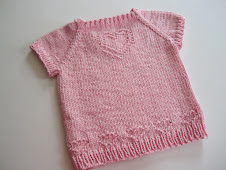
Updated patterns!

I'm in the process of updating my old patterns, particularly the bibs, to include charts. I'm rewriting some of the directions to make the patterns even easier and including alternative methods for beginning the bibs and for making the ties. Look for these patterns in the sidebar to see which ones have been added. It's a slow process, but eventually, they'll all be there!


Wednesday, August 3, 2011

An earthquake?

No, that rumbling the in the northeast was not an earthquake.  It was just my husband and me jumping up and down for joy!  We found out that we're going to be grandparents again!  You might remember that my daughter-in-law was diagnosed with cancer last year.  What you don't know is that it was discovered after she lost a baby.  I'm happy to report that she is now cancer free and the doctors gave her the go ahead to try again.  So far, everything seems to be going along well and I couldn't be happier.  Of course, I have to confess that I am keeping my fingers crossed.  That makes it a little difficult to knit, but I did manage to uncross them long enough to knit some adorable little booties.
This is a free pattern that's been around for awhile.  The booties are called "Christine's Baby Booties" and you can find the pdf file here.  The pattern leaves a little to be desired in terms of detailed instructions, but it is easy to knit.  I used Knit Picks Felici in the Rainbow colorway and size 2.5mm needles.


I thought about making them match, but then again, we're not big on coordinating clothing in this family among the younger set.   It's not unusual for my grandsons to turn up with each of them wearing a different colored Croc on each of their feet.  This baby might as well get used to that right from the start.

I did modify the pattern a little since my grandbabies are notorious for having big feet.  I cast on 12 stitches. and knit 20 ridges, then I just did extra decreases until I got back down to the original 40 stitches called for in the pattern.  Since this little one is due to make an appearance in late January, I knit extra rounds at the top so they could be pulled up to the knees in the cold weather.  The ties are I-cords that I knit with 4 stitches. and are about 20 inches long.


In other news, Sarah Franklin  asked to interview me for her blog.  I think she's going to post it today or tomorrow.  If you're interested you can check it out.  Also, I'm currently sponsoring another KAL for the Monthly Dishcloth Group on Yahoo, so I'll have a brand new pattern to post when that ends on Sunday.  Hmmm, I wonder if this baby will wear a bib?  Is so, I have enough for a lifetime!

Friday, July 22, 2011

Among the Hydrangeas

I finally finished my pretty shawl from Sarah Franklin called "Among the Heather".  This was the KAL that was sponsored on Ravelry and I was excited to do it.  I love Sarah's patterns (especially her sock patterns) and I've never participated in a KAL for any project other than a dishcloth! 


Turns out, I was the only one who participated, so it was the same as if I just knit any regular project! Oh well, I didn't mind as it's very pretty.  I actually finished awhile ago, but I finally got around to blocking it.


The yarn is 100% hand dyed bamboo that I bought on Etsy a few years ago.  Unfortunately, it's no longer available and I haven't been able to find a suitable alternative yet.  I didn't have quite as much yardage as the pattern called for, so I had to cut out a couple of repeats in order for it to work.  As it turned out, I had more than I thought and I wanted to use as much as I could, so the edge of the shawl has more rows than I normally would do.


To say that this yarn is incredibly splitty, is an understatement.  I had to concentrate on every stitch, but then again, it is lace and I have to pay attention anyway!  It does have a beautiful drape and sheen.  My sister has her eye on it, but there is no way I'm letting her have it!  For once, I actually knit something for myself! 


Check out my beautiful hydrangeas!  They're called "Endless Summer" and depending on the soil, they're either pink or blue. Aren't they gorgeous?  I live in a big old Victorian house with this wrap around porch and I planted them a couple of years ago.   The first year they didn't do much and last year I only had a few blossoms.  This year, they've really taken off and I just love them.


I actually bought them at my grocery store!  I figured if they could keep them alive, then they'd stand a pretty good chance of surviving at my house too!

Monday, July 18, 2011

Meet Fred

Fred is the pilot husband of a good friend of mine, who had an unfortunate plane crash in Australia. Fortunately, he and his passengers were unhurt, however, they narrowly missed having a close encounter with some Kakadu crocodiles.  You know. . . those really big man eating crocs!  Therefore, it seems only fitting that this pattern should be named in honor of Fred.  Let’s hope this is the closest he ever comes to the real thing!

Both the cloth and the bib are knitted in Peaches & Creme, the cloth in Apple Green and the bib in Baby Pink.  I'm sure there are girl crocodiles so this seemed like a logical choice.  As a matter of fact, it's probably because of all the motherly nurturing that the boy crocs turn out to be so big.  On the other hand, their dispositions must come from the father's side of the family!  Just my opinion of course.

Fred the Croc Cloth

Copyright 2011 by Elaine Fitzpatrick. Permission is granted to make and sell items from this pattern provided that credit is given to me as the designer.  Permission is not granted to reproduce the actual pattern, or post it, or distribute it, without my express permission.  Please respect my copyright and play nice!

The pdf, which also includes a chart, is available in the side bar or by clicking HERE.
Size:  approximately 8" X 8 ¼ ".

Materials:  One skein of worsted weight cotton in a solid color.  Approximately 98 yards. The cloth pictured was done in Peaches & Crème in Apple Green.

Needles:  U.S. Size 6/4.0mm or 5/3.75mm  Because this is a “picture” cloth, you want your fabric to be fairly dense so the design will pop out.  If you are a loose knitter, then you might want to drop down a needle size.

Gauge:  4.5 sts. per inch, not critical. 

Abbreviations:
k = knit
p = purl
sts. = stitches

Pattern:

Cast on 37 stitches
Rows 1 – 7:  (k1, p1) across row.
Row 8:  (wrong side) (k1, p1) x2; k1; p16; k3; p8; k1; (p1, k1) x2.
Row 9:  (k1, p1) x2; k8; p1; k20; (p1, k1) x2.
Row 10:  (k1, p1) x2; k1; p16; k1; p3; k1; p6; k1; (p1, k1) x2.
Row 11:  (k1, p1) x2; k29; (p1, k1) x2.
Row 12:  (k1, p1) x2; k1; p16; k3; p8; k1; (p1, k1) x2.
Row 13:  (k1, p1) x2; k8; p1; k20; (p1, k1) x2.
Row 14:  (k1, p1) x2; k1; p16; k1; p3; k1; p6; k1; (p1, k1) x2.
Row 15:  (k1, p1) x2; k6; p1; k22; (p1, k1) x2.
Row 16:  (k1, p1) x2; k1; p16; k3; p8; k1; (p1, k1) x2.
Row 17:  (k1, p1) x2; k8; p1; k20; (p1, k1) x2.
Row 18:  (k1, p1) x2; k1; p16; k1; p10; k1; (p1, k1) x2.
Row 19:  (k1, p1) x2; k29; (p1, k1) x2.
Row 20:  (k1, p1) x2; k1; p16; k1; p10; k1; (p1, k1) x2.
Row 21:  (k1, p1) x3; k10; p3; k3; p3; k8; (p1, k1) x2.
Row 22:  (k1, p1) x2; k1; p6; k1; p3; k3; p3; k1; p8; k1; (p1, k1) x3.
Row 23:  (k1, p1 ) x2; k3; p1; k6; p1; k11; p1; k6; (p1, k1) x2.
Row 24:  (k1, p1) x2; k1; p2; k6; p10; k4; (p2, k1) x2; (p1, k1) x2.
Row 25:  (k1, p1) x2; k4; p2; k7; p3; k2; p2; k6; p1; k2; (p1, k1) x2.
Row 26:  (k1, p1) x3; k1; p8; k2; p3; k1; p8; k1; p2; k1; (p1, k1) x2.
Row 27:  (k1, p1) x2; k2; p1; k7; p2; k14; p1; k2; (p1, k1) x2.
Row 28:  (k1, p1) x3; k1; p16; k1; p6; k1; (p1, k1) x3.
Row 29:  (k1, p1) x2; k2; p1; k5; p1; k12; p1; k2; p2; k3; (p1, k1) x2.
Row 30:  (k1, p1) x2; k1; p4; k2; p19; k1; (p1, k1) x3.
Row 31:  (k1, p1) x2; k2; p1; k13; p1; k4; p1; k7; (p1, k1) x2.
Row 32:  (k1, p1) x2; k1; p7; k1; p2; k1; p13; k1; p2; k1; (p1, k1) x2.
Row 33:  (k1, p1) x2; k3; p1; k14; p2; k9; (p1, k1) x2.
Row 34:  (k1, p1) x2; k1; p10; k1; p12; k1; p3; k1; (p1, k1) x2.
Row 35:  (k1, p1) x2; k4; p1; k12; p1; k11; (p1, k1) x2.
Row 36:  (k1, p1) x2; k1; p11; k2; p10; k1; p3; k1; (p1, k1) x2.
Row 37:  (k1, p1) x2; k4; p1; k1; p3; k3; p3; k14; (p1, k1) x2.
Row 38:  (k1, p1) x2; k1; p12; k1; p3; k1; p1; k1; p3; k1; p4; k1; (p1, k1) x2.
Row 39:  (k1, p1) x2; k4; (p1, k2) x2; p1; k5; p1; k12; (p1, k1) x2.
Row 40:  (k1, p1) x2; k1; p11; (k1, p2) x2; k1; p5; k1; p3; k1; (p1, k1) x2.
Row 41:  (k1, p1) x2; k4; (p1, k5) x2; p1; k12; (p1, k1) x2.
Row 42:  (k1, p1) x2; k1; p11; (k1, p5) x2; k1; p3; k1; (p1, k1) x2.
Row 43:  (k1, p1) x2; k5; p1; k3; p1; k1; p1; k3; p1; k13; (p1, k1) x2.
Row 44:  (k1, p1) x2; k1; p13; k3; p3; k3; p5; k1; (p1, k1) x2.
Row 45:  (k1, p1) x2; k29; (p1, k1) x2.
Row 46:  (k1, p1) x2; k1; p27; k1; (p1, k1) x2.
Row 47:  (k1, p1) x3; k25; (p1, k1) x3.
Row 48:  (k1, p1) x3; k1; p23; k1; (p1, k1) x3.
Row 49:  (k1, p1) x4; k21; (p1, k1) x4.
Row 50:  (k1, p1) x4; k1; p19; k1; (p1, k1) x4.
Row 51:  (k1, p1) x5; k17; (p1, k1) x5.
Rows 52 - 58: ( k1, p1) across row.
Bind off in k1, p1 and weave in ends.

Fred the Croc Bib


Copyright 2011 by Elaine Fitzpatrick. Permission is granted to make and sell items from this pattern provided that credit is given to me as the designer.  Permission is not granted to reproduce the actual pattern, or post it, or distribute it, without my express permission.  Please respect my copyright and play nice!

The PDF file, which includes a chart, is available in the side bar or by clicking HERE .

Size:  approximately 8" from neck edge to bottom and 7 ½" wide

Materials:  One skein of worsted weight cotton in a solid color such as Peaches & Crème or Sugar ‘n Cream (approximately 98 yards) if you are using the bib for meals.  If, on the other hand, you want to use it as a “drool” bib, I would recommend using a superwash wool.  The cotton has a tendency to absorb the moisture, whereas the superwash wool will wick the moisture and keep baby nice and dry!   Sample was done in Peaches & Crème Baby Pink.

Needles:        US 5/3.75 mm or 6/4.0mm  You want the bib to be fairly dense, so if the fabric is too loose, just drop down a needle size.

2 double pointed needles US 5/3.75 mm for the knitted I-cord ties
                or
Size G crochet hook for the crocheted ties

Gauge:  4.5 sts. per inch, not critical.

PATTERN NOTES
This pattern allows you to choose between two methods of beginning the bib.  One uses short rows and the other, more traditional way, requires you to cast on stitches at the beginning of the first few rows of the pattern. There are also two methods for doing the ties.  One has crocheted ties and the other method uses knitted I-cords. The crocheted ties are slightly thinner.  If you do make the knitted ties, you can drop down a needle size when knitting the cords. I like to run a long tail down the center of the cord to finish it off. Be sure to use a straight needle and not one with a bent tip!


Abbreviations:
k = knit
p = purl
psso:  pass slipped stitch over
k2tog.= knit 2 stitches together
p2tog.=purl 2 stitches together
sts. = stitches
dec. = decrease
dpn. = double pointed needle

Short Row Version

For this method, you don’t have to wrap stitches or pick up wraps.  You just work the stitches to a point and turn your work around and start knitting in the opposite direction. I’ve written out every row for you and I’ve indicated how many stitches you should have remaining at the end of each row.  If you lose your count, all you have to do is check on the number of stitches you have left on your needle and you’ll be right back on track.  This technique results in a nice smooth edge.

Cast on 37 stitches
Row 1:  k1, p1 for 26 sts.; turn (11 sts. unworked)
Row 2:  Slip 1 knitwise; k1, p1 for 17 sts.; turn (8 sts. unworked)
Row 3:  Slip 1 knitwise; p1, k1 for 20 sts.; turn (8 sts. unworked)
Row 4:  Slip 1 knitwise; p1, k1 for 23 sts.; turn (5 sts. unworked)
Row 5:  Slip 1 knitwise; k1, p1 for 26 sts.; turn (5 sts. unworked)
Row 6:  Slip 1 knitwise; k1, p1 for 28 sts.; turn (3 sts. unworked)
Row 7:  Slip 1 knitwise; k1, p1 for 30 sts.; turn (3 sts. unworked)
Row 8:  Slip 1 knitwise; k1, p1 for 32 sts.; turn (1 sts. unworked)
Row 9:  Slip 1 knitwise; k1, p1 for 34 sts.; turn (1 sts. unworked)
Row 10:  Slip 1 knitwise; k1, p1 for 35 sts.
Row 11:  k1, p1 across row.
Continue with *Row 12 of pattern.
OR
Traditional Beginning

Pattern:  Cast on 15 sts.

Row 1:  p1, k1 across row.
Row 2:  Cast on 3 sts., k1, p1 across row. (18 sts.)
Row 3:  Cast on 3 sts., k1, p1 across row. (21 sts.)
Row 4:  Cast on 3 sts., p1, k1 across row.  (24 sts.)
Row 5:  Cast on 3 sts., p1, k1 across row.  (27 sts.)
Row 6:  Cast on 3 sts., k1, p1 across row.  (30 sts.)
Row 7:  Cast on 3 sts., k1, p1 across row.  (33 sts.)
Row 8:  Cast on 2 sts., k1, p1 across row.  (35 sts.)
Row 9:  Cast on 2 sts., k1, p1 across row.  (37 sts.)
Row 10:  k1, p1 across row.
Row 11:  k1, p1 across row.
*Row 12:  (wrong side) (k1, p1) x2; k1; p16; k3; p8; k1; (p1, k1) x2.
Row 13:  (k1, p1) x2; k8; p1; k20; (p1, k1) x2.
Row 14:  (k1, p1) x2; k1; p16; k1; p3; k1; p6; k1; (p1, k1) x2.
Row 15:  (k1, p1) x2; k29; (p1, k1) x2.
Row 16:  (k1, p1) x2; k1; p16; k3; p8; k1; (p1, k1) x2.
Row 17:  (k1, p1) x2; k8; p1; k20; (p1, k1) x2.
Row 18:  (k1, p1) x2; k1; p16; k1; p3; k1; p6; k1; (p1, k1) x2.
Row 19:  (k1, p1) x2; k6; p1; k22; (p1, k1) x2.
Row 20:  (k1, p1) x2; k1; p16; k3; p8; k1; (p1, k1) x2.
Row 21:  (k1, p1) x2; k8; p1; k20; (p1, k1) x2.
Row 22:  (k1, p1) x2; k1; p16; k1; p10; k1; (p1, k1) x2.
Row 23:  (k1, p1) x2; k29; (p1, k1) x2.
Row 24:  (k1, p1) x2; k1; p16; k1; p10; k1; (p1, k1) x2.
Row 25:  (k1, p1) x3; k10; p3; k3; p3; k8; (p1, k1) x2.
Row 26:  (k1, p1) x2; k1; p6; k1; p3; k3; p3; k1; p8; k1; (p1, k1) x3.
Row 27:  (k1, p1 ) x2; k3; p1; k6; p1; k11; p1; k6; (p1, k1) x2.
Row 28:  (k1, p1) x2; k1; p2; k6; p10; k4; (p2, k1) x2; (p1, k1) x2.
Row 29:  (k1, p1) x2; k4; p2; k7; p3; k2; p2; k6; p1; k2; (p1, k1) x2.
Row 30:  (k1, p1) x3; k1; p8; k2; p3; k1; p8; k1; p2; k1; (p1, k1) x2.
Row 31:  (k1, p1) x2; k2; p1; k7; p2; k14; p1; k2; (p1, k1) x2.
Row 32:  (k1, p1) x3; k1; p16; k1; p6; k1; (p1, k1) x3.
Row 33:  (k1, p1) x2; k2; p1; k5; p1; k12; p1; k2; p2; k3; (p1, k1) x2.
Row 34:  (k1, p1) x2; k1; p4; k2; p19; k1; (p1, k1) x3.
Row 35:  (k1, p1) x2; k2; p1; k13; p1; k4; p1; k7; (p1, k1) x2.
Row 36:  (k1, p1) x2; k1; p7; k1; p2; k1; p13; k1; p2; k1; (p1, k1) x2.
Row 37:  (k1, p1) x2; k3; p1; k14; p2; k9; (p1, k1) x2.
Row 38:  (k1, p1) x2; k1; p10; k1; p12; k1; p3; k1; (p1, k1) x2.
Row 39:  (k1, p1) x2; k4; p1; k12; p1; k11; (p1, k1) x2.
Row 40:  (k1, p1) x2; k1; p11; k2; p10; k1; p3; k1; (p1, k1) x2.
Row 41:  (k1, p1) x2; k4; p1; k1; p3; k3; p3; k14; (p1, k1) x2.
Row 42:  (k1, p1) x2; k1; p12; k1; p3; k1; p1; k1; p3; k1; p4; k1; (p1, k1) x2.
Row 43:  (k1, p1) x2; k4; (p1, k2) x2; p1; k5; p1; k12; (p1, k1) x2.
Row 44:  (k1, p1) x2; k1; p11; (k1, p2) x2; k1; p5; k1; p3; k1; (p1, k1) x2.
Row 45:  (k1, p1) x2; k4; (p1, k5) x2; p1; k12; (p1, k1) x2.
Row 46:  (k1, p1) x2; k1; p11; (k1, p5) x2; k1; p3; k1; (p1, k1) x2.
Row 47:  (k1, p1) x2; k5; p1; k3; p1; k1; p1; k3; p1; k13; (p1, k1) x2.
Row 48:  (k1, p1) x2; k1; p13; k3; p3; k3; p5; k1; (p1, k1) x2.
Row 49:  (k1, p1) x2; k29; (p1, k1) x2.
Row 50:  (k1, p1) x2; k1; p27; k1; (p1, k1) x2.
Row 51:  (k1, p1) x3; k25; (p1, k1) x3.
Row 52:  (k1, p1) x3; k1; p23; k1; (p1, k1) x3.
Row 53:  (k1, p1) x4; k21; (p1, k1) x4.
Row 54:  (k1, p1) x4; k1; p19; k1; (p1, k1) x4.
Row 55:  (k1, p1) x5; k17; (p1, k1) x5.
Rows 56 - 62:  k1, p1 across row.
Row 63:   k1, p1 for 13 sts.  Slip sts. just worked onto stitch holder, bind off the next 11 stitches knitwise; work across remaining sts. in established pattern: 13 stitches each side.

NECK AND SHOULDER SHAPING – LEFT SHOULDER
Note: As you look at the bib with the right side facing, the first shoulder worked will be the left side. All the decreases are made on right side or odd numbered rows.

Row 64:  (wrong side) k1, p1 across row.

Neck decreases:
Row 65:   Slip 1 knitwise, k1, psso; k1, p1 across row. (12 sts.)
Row 66:  k1, p1 across row.
Row 67:   Slip 1 knitwise, k1, psso; p1, k1 across row. (11 sts.)
Row 68:  k1, p1 across row.
Shoulder decreases:
Row 69:  k1, p1 across to last 2 sts, p2tog.  (10 sts.)
Row 70:  p1, k1 across row.
Row 71:  k1, p1 across to last 2 sts., k2tog.  (9 sts.)
Row 72:  k1, p1 across row.
Row 73:  k1, p1 across to last 2 sts., p2tog.  (8 sts.)
Row 74:  p1, k1 across row.
Row 75:  k1, p1 across to last 2 sts., k2tog.  (7 sts.)
Row 76:  k1, p1 across row.
Row 77:  k1, p1 across to last 2 sts., p2tog.  (6 sts.)
Row 78:  p1, k1 across row.
Row 79:  k1, p1 across to last 2 sts., k2tog.  (5 sts.)
Row 80:  k1, p1 across row.
Row 81:  Slip 1 knitwise, k1, psso; k1, p2 tog.  (3 sts.)

For the crocheted ties, slip your crochet hook through the three stitches and draw your yarn through.  Then work a chain for about 12 - 14 inches.  The crocheted ties are not as stretchy as the knitted ones, so you might want to make these slightly longer.  When you reach the desired length, work back on the chain by inserting your hook in the second chain stitch nearest the end and slip stitch in each chain until you are back to the beginning.  Fasten the yarn securely and weave in the ends.  I have a “mini-tutorial” for making the crocheted ties on my blog.  http://downcloverlaine.blogspot.com/2010/05/ties-that-bind.html

For the knitted ties, slip these 3 sts. to a dpn work an I-cord for approximately 12 inches.  Fasten off and run end down through middle of I-cord.  Don't worry if the
I-cords look a little wonky.  A firm tug will usually straighten them out and after the bib is washed, you won't even notice!  A good tutorial for making the I-cords can be found here:  http://www.knittinghelp.com/videos/knitting-tips


NECK AND SHOULDER SHAPING – RIGHT SHOULDER
With wrong side facing, slip sts. from stitch holder to left needle and join yarn at neck edge.  All the decreases are made on right side or odd numbered rows.

 Row 64:  (wrong side) k1, p1 across row.

Neck decreases:
Row 65:  k1, p1 across to last 2 sts., p2tog.  (12 sts.)
Row 66:  p1, k1 across row.
Row 67:  k1, p1 across to last 2 sts., k2tog.  (11 sts.)
Row 68:  k1, p1 across row.

Shoulder decreases:
Row 69:  Slip 1 knitwise, k1, psso; k1, p1 across row.  (10 sts.)
Row 70:  k1, p1 across row.
Row 71:  Slip 1 knitwise, k1, psso; p1, k1 across row.  (9 sts.)
Row 72:  k1, p1 across row.
Row 73:  Slip 1 knitwise, k1, psso; k1, p1 across row.  (8 sts.)
Row 74:  k1, p1 across row.
Row 75:  Slip 1 knitwise, k1, psso; p1, k1 across row.  (7 sts.)
Row 76:  k1, p1 across row.
Row 77:  Slip 1 knitwise, k1, psso; k1, p1 across row.  (6 sts.)
Row 78:  k1, p1 across row.
Row 79:  Slip 1 knitwise, k1, psso;  p1, k1 across row.  (5 sts.)
Row 80:  k1, p1 across row.
Row 81:  Slip 1 knitwise, k1, psso; k1; p2tog.  (3 sts.)
Work tie to correspond with the one you worked for the other side.

Weave in ends.